
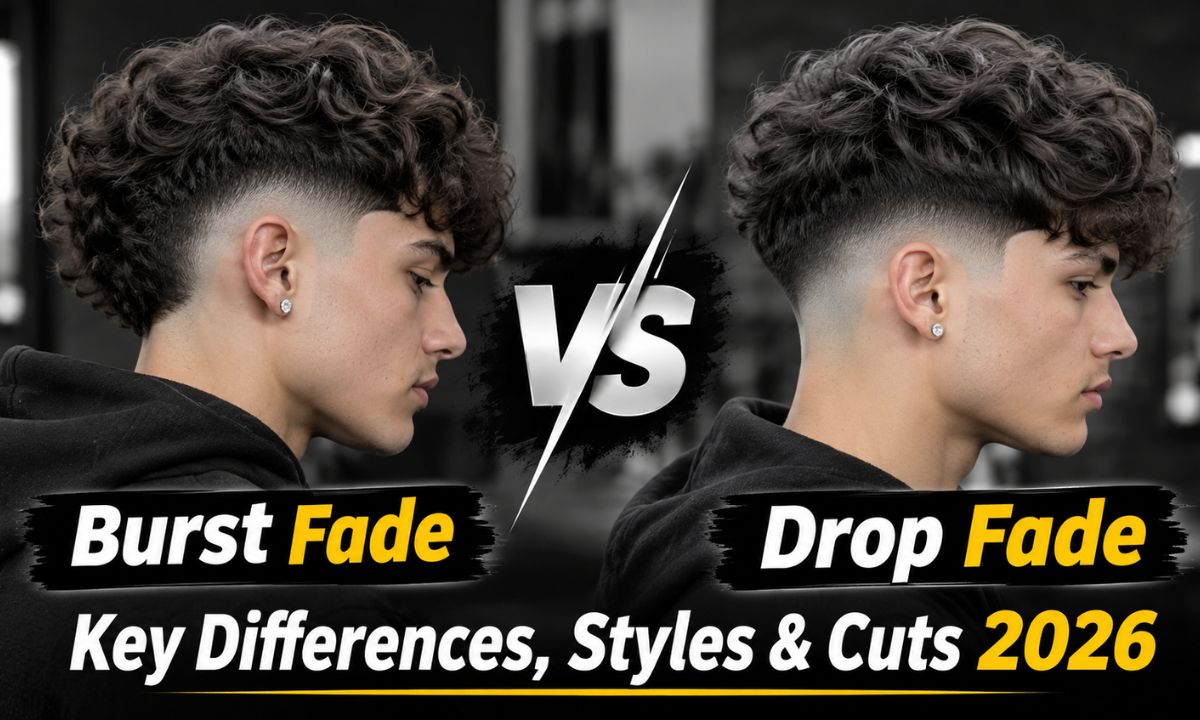
Barbers use two words all the time: burst and drop. Clients hear them and nod, but many are not sure what they mean. Both fades look sharp. Both work with modern hairstyles. Yet they shape your head in very different ways.
A burst fade curves around the ear like a half circle. A drop fade follows the ear and then dips lower toward the neck. That one change affects how your cut looks from the side and from behind. It also changes how your cut grows out.
This guide explains both cuts in plain words. You will see how they differ, how they work on different hair types, and how to pick the right one. You will also learn how to ask your barber and how to keep the cut fresh. Whether you are in a big city shop or a small neighborhood barbershop, this guide will help you walk in with confidence.
Burst Fade vs Drop Fade: Five Matched Visual Comparisons
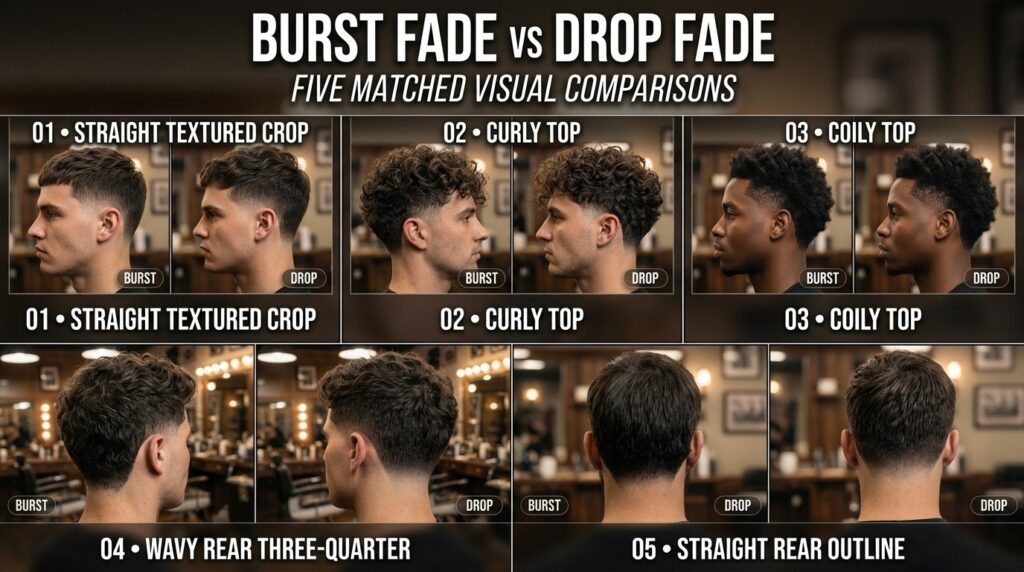
The best way to see the difference is to look at the same hairstyle with each fade. Below are five common looks. Picture each one with a burst fade on one side and a drop fade on the other.
The top stays the same in each pair. Only the fade changes. That makes the difference easy to spot.
Straight Textured Crop
A textured crop has short, choppy hair on top and a blunt fringe. It is one of the most popular cuts for straight hair in the US.
With a burst fade, the sides look rounded and clean around the ear. The back keeps some weight, so the crop looks soft and balanced. With a drop fade, the line sweeps down behind the ear and makes a clear curve toward the neck. The result looks sharper and more modern.
Curly Top
Curly hair on top adds volume and shape. A fade gives it a neat frame.
A burst fade looks great here because the curls sit above a smooth semicircle. The back can stay fuller, which suits a natural curl pattern. A drop fade gives a more dramatic edge. The curls feel lifted, and the lower line makes your head look longer from the side.
Coily Top
Coily hair holds a shape well. It makes fades look very crisp.
A burst fade on coily hair shows a strong, clean curve around the ear. The contrast between the dense top and the skin-short sides is bold. A drop fade adds a lower arc that follows the skull. It looks clean from the back and gives a sculpted finish.
Wavy Rear Three-Quarter
Now picture the cut from behind and to the side. This angle shows the fade best.
A burst fade on wavy hair shows a circle of short hair around the ear, while the back remains longer. A drop fade shows a smooth line that drops behind the ear and runs down toward the nape. Waves flow over both cuts, but the drop version looks cleaner and more stretched.
Straight Rear Outline
Straight hair shows every line, so the outline matters most here.
A burst fade creates a rounded, soft outline. A drop fade creates a curved, flowing outline that follows the head. If your barber does a neat job, either one looks great. If the cut is rushed, straight hair will show every mistake.
Here is a quick view of all five pairs side by side.
| Hair Type / Angle | Burst Fade Effect | Drop Fade Effect |
| Straight textured crop | Soft, rounded, balanced | Sharp, modern, curved |
| Curly top | Full back, framed curls | Lifted curls, longer side profile |
| Coily top | Bold circle, strong contrast | Sculpted arc, clean back |
| Wavy rear three-quarter | Circle of short hair, longer back | Smooth drop toward the nape |
| Straight rear outline | Soft outline | Flowing outline |
Burst Fade vs Drop Fade: Three Placement References
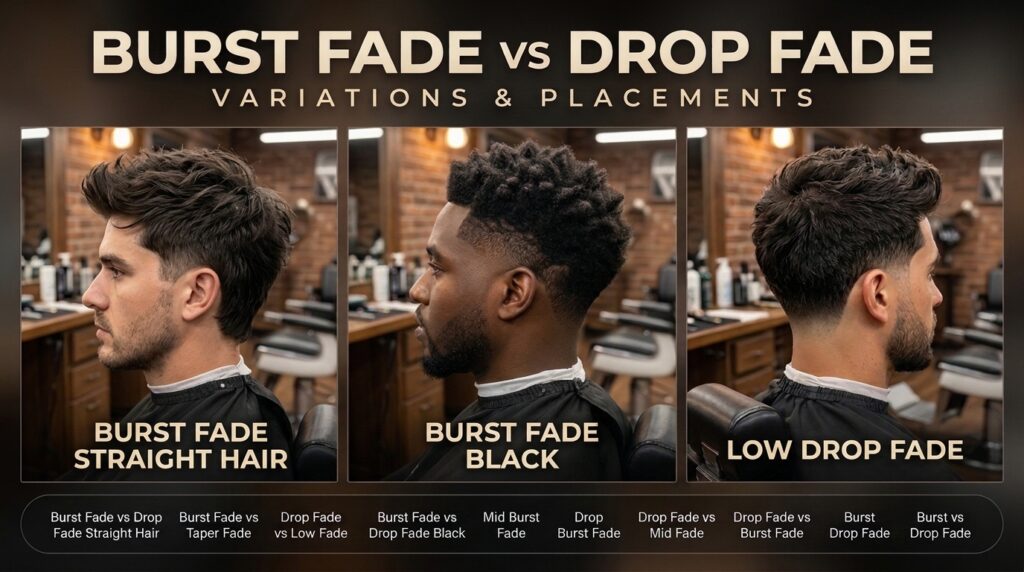
Where the fade starts and ends decides everything. Think of it as placement. Is the fade high, mid, or low? Does it wrap the ear or drop behind it? The sections below break down the most common comparisons people search for.
Burst Fade vs Drop Fade Straight Hair
Straight hair lies flat. That means it shows the faded shape very clearly.
A burst fade on straight hair gives a rounded look. It works well with a side part, a crop, or a quiff. A drop fade gives a more athletic look. The dropped line adds a bit of edge, which suits slicked-back styles and textured tops.
Straight hair also grows out in a smooth line. Any uneven blending will show up quickly. Pick a barber who is confident with clipper work.
Burst Fade vs Taper Fade
A taper fade is the simplest fade. The hair gets shorter as it moves down the sides and back. It follows the natural hairline and keeps things subtle.
A burst fade is bolder. It focuses on the ear and spreads out in a curve. A taper is calm and classic. A burst is shaped and styled. If you work in a formal office, a taper may be the safer choice. If you want a style that stands out, go with the burst.
Read More: Burst Fade Mullet
| Feature | Burst Fade | Taper Fade |
| Shape | Semicircle around the ear | Follows the natural hairline |
| Mood | Bold and stylish | Clean and classic |
| Back length | Usually longer | Usually short and tidy |
| Best for | Mullets, curls, textured tops | Business and everyday looks |
Burst Fade Mullet
The burst fade mullet is one of the biggest trends of the last few years. The sides are faded around the ear, and the back stays long.
This works because the burst fade keeps the length at the nape. The faded sides make the mullet look neat instead of messy. You get the shape of a mullet with a more modern finish.
A drop fade can work with a mullet too, but it takes more skill. The line dips low, so the back length needs careful planning. Most barbers suggest the burst for a mullet because it keeps the shape stronger.
Drop Fade vs Low Fade
A low fade starts near the bottom of the head, just above the ear and the neckline. It is gentle and keeps most of the side hair.
A drop fade can also start low, but the line curves down behind the ear. A low fade stays level. A drop fade drops. That is the key difference.
| Feature | Low Fade | Drop Fade |
| Line direction | Straight and level | Curves down behind the ear |
| Starting point | Low on the head | Can be low, mid, or high |
| Style | Subtle | Sharper and more shaped |
You can also have a low drop fade. This gives you the best of both. It stays quiet at the top and has a nice dip at the back.
Burst Fade vs Drop Fade Black
Many Black men choose these cuts, and both work very well on tight curls and coils. The skin shows clearly through the faded area. That makes the contrast crisp.
A burst fade on coily hair looks neat and rounded. It pairs well with twists, a high top, or short waves. A drop fade adds a longer visual line. It works well with waves, a sponge twist, or a clean line-up.
Keep in mind that a close fade shows ingrown hairs and razor bumps more easily. Ask your barber to use a clean blade and a light touch. Moisturize your scalp after the cut.
Mid Burst Fade
A mid burst fade starts about halfway up the sides. It sits between a low and a high burst.
This is the most balanced version. It is bold enough to look new but not so bold that it feels extreme. If you are trying a burst fade for the first time, a mid burst is a safe place to start.
It works well with a crop, a quiff, curls, or a short mullet. It also grows out in a neat way, which helps you stretch the time between cuts.
Drop Burst Fade
Some barbers combine both fades. In a drop burst fade, the fade circles the ear like a burst. Then it drops lower behind the ear like a drop fade.
This hybrid is covered in more detail below. For now, remember this: it is not a separate cut with strict rules. It is a mix. Your barber can adjust how much burst and how much drop you want.
Drop Fade vs Mid Fade
A mid fade starts at the middle of the sides. It is a very common choice. It keeps the line straight and even around the head.
A drop fades, in contrast, curves down. A mid fade is level and clean. A drop fade is shaped and curved. If you like neat and simple, pick the mid fade. If you want a cut with more flow, pick the drop.
You can also mix them. A mid drop fade starts at the middle and then dips behind the ear. It is a nice middle ground.
Drop Fade vs Burst Fade
Here is the short version. A drop fade changes the line behind the ear. A burst fade changes the shape around the ear.
The drop fade is about direction. It goes down. The burst fade is about shape. It goes round. Neither one is better. They simply do different jobs.
Burst Fade vs Drop Fade
The two cuts share a few things. Both blend short sides into longer hair on top. Both look good with many hair types. Both need a skilled barber.
They differ in the details. A burst fade keeps more length at the back and highlights the ear. A drop fade removes more length at the back and highlights the neck line. Your head shape, hair type, and style goals will tell you which one suits you.
Drop Burst Fade
You will often see this name used for the hybrid cut. It blends the round frame of a burst with the lower sweep of a drop.
On the head, it looks like one long, smooth curve. It starts around the ear and finishes low near the nape. Many barbers like it because it shows off blending skill. Many clients like it because it feels new without being too wild.
Burst Drop Fade
Burst drop fade is another name some people use for the same hybrid. The words can be swapped. When you ask for it, add a short description. Say that you want a curve around the ear that drops lower behind it.
Clear words help your barber. Names can mean different things in different shops.
Burst vs Drop Fade
People often type this short phrase into search engines. They want a quick answer. Here it is.
A burst fade circles the ear and leaves the back longer. A drop fade curves behind the ear and goes lower toward the neck. Choose burst for volume and a rounded shape. Choose a drop for a sleek, long line.
Compare Your Preferences First
Before you book, think about what you want. A good haircut starts with a clear idea, not a name.
Ask yourself a few simple questions.
- Do I want a bold look or a soft look?
- Do I want to keep the length at the back?
- How often can I visit my barber?
- What does my work or school expect?
- What is my hair type?
Your answers point you in the right direction. If you love length at the back, lean toward a burst. If you want a sharp line at the neck, lean toward a drop. If you want something quiet, choose a lower placement for either one.
It also helps to bring pictures. Show your barber the front, the side, and the back. One photo is rarely enough. A back view is especially useful for these fades.
Your lifestyle matters as well. Athletes and people who wear hats or helmets often prefer a tidy, lower fade. People who style their hair daily may like the bold shapes of a burst. Think about your budget too. Cuts that need a visit every two weeks cost more over a year than cuts that last a month.
Burst Fade vs Drop Fade at a Glance
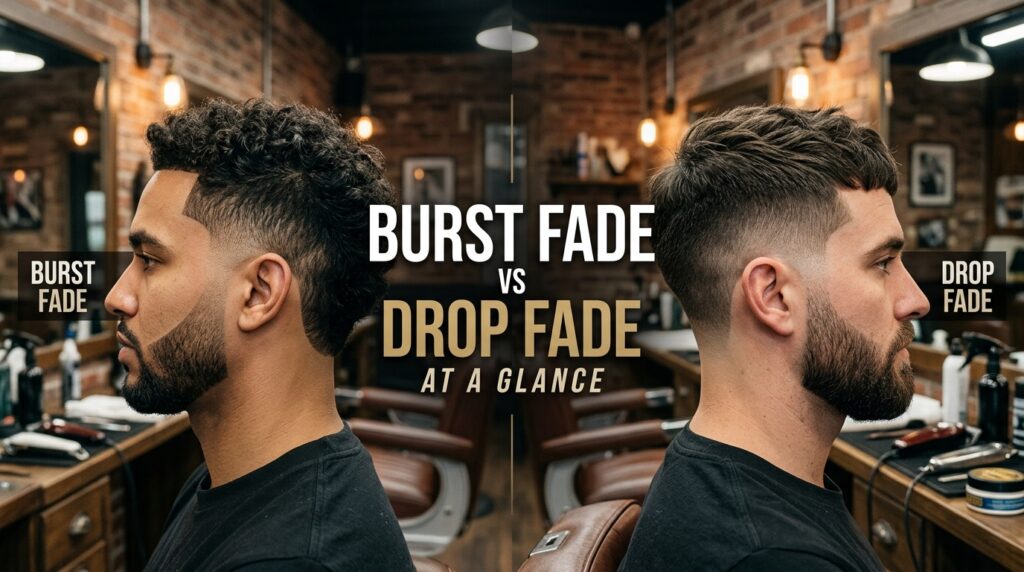
Here is a simple table that sums up the main points.
| Feature | Burst Fade | Drop Fade |
| Main shape | Semicircle around the ear | Curve that dips behind the ear |
| Back length | Usually kept longer | Usually shorter at the nape |
| Visual effect | Rounded and bold | Sleek and sharp |
| Best with | Mullets, curls, textured tops | Crops, waves, slick styles |
| Skill level | Medium to high | Medium to high |
| Grow-out | Soft and gradual | Can look uneven sooner |
| Style mood | Trendy and playful | Clean and athletic |
Both cuts can be made low, mid, or high. Both can be a skin fade or a shadow fade. This means you can adjust the look to suit your taste.
If you only remember one thing, remember this. Burst is about the ear. Drop is about the line behind the ear.
What a Burst Fade Actually Does
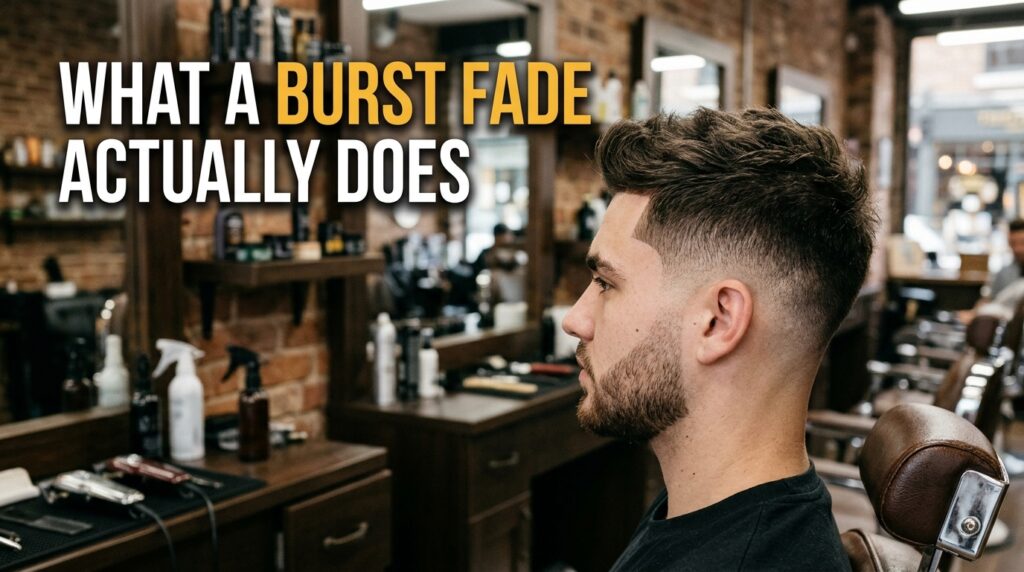
A burst fade is a fade that bursts out from the ear like a half circle. The barber trims the hair around the ear very short. Then the hair gets longer as it moves away from the ear in a curve.
The back of the head usually keeps more length. That is the key trait. The fade does not run all the way down to the neck. Instead, it wraps around the ear and stops.
This shape has a few clear effects.
- It frames the ear and gives the side a rounded look.
- It keeps weight at the back, so the head looks fuller from behind.
- It makes the top and back look connected.
- It pairs well with longer hair at the nape.
That is why the burst fade is such a common pick for mullets. It also works for curly tops, long fringes, and taper styles that need more shape.
There are three main versions.
| Version | Where It Starts | Look |
| Low burst | Just above the ear | Soft and subtle |
| Mid burst | Halfway up the side | Balanced and popular |
| High burst | Near the temple | Bold and strong |
The burst fade does need skill. The curve must be smooth. A bad blend makes the ear look patchy. A good barber will take their time and check from all angles.
One more point. Because the back stays long, this cut hides small mistakes in the neckline. It is also a bit forgiving when it grows out. That can be a plus if you do not visit the barber every week.
What a Drop Fade Actually Does
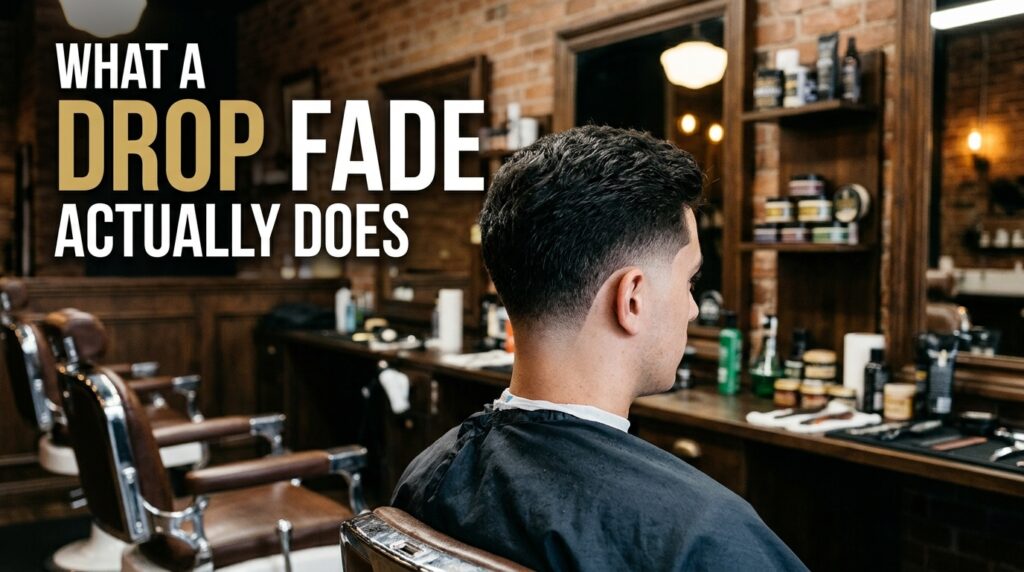
A drop fade changes the line of the fade as it moves around the head. Near the front, the fade starts at a certain height. Behind the ear, the line “drops” down toward the neck.
This creates a smooth curve that follows the shape of your skull. It looks like a gentle wave from the side. From behind, it looks like an arch.
The drop fade has a few clear effects.
- It makes the back of the head look cleaner and longer.
- It draws attention to the neckline.
- It adds a sleek, athletic feel.
- It works well with a sharp line-up.
The drop can be low, mid, or high. A low drop fade is calm. A high drop fade is bold. Most people choose a low or mid drop because it looks neat and still feels modern.
| Version | Look | Good For |
| Low drop | Soft curve near the neck | Work and everyday wear |
| Mid drop | Balanced and stylish | Most hair types |
| High drop | Strong and dramatic | Bold hairstyles |
The drop fade also helps people who want to shape their head. If your head is flat at the back, the curve can create a softer line. If your head is round, the drop adds a clean edge.
A drop fade needs care at the neck. The line must be smooth and even on both sides. A good barber checks the line in the mirror and from behind. If the two sides do not match, the cut will look off.
Because the line sits lower at the back, it shows growth sooner. You may notice the hair on your neck coming back after two weeks. This is normal. A quick clean-up keeps it sharp.
The Ear and Nape Test
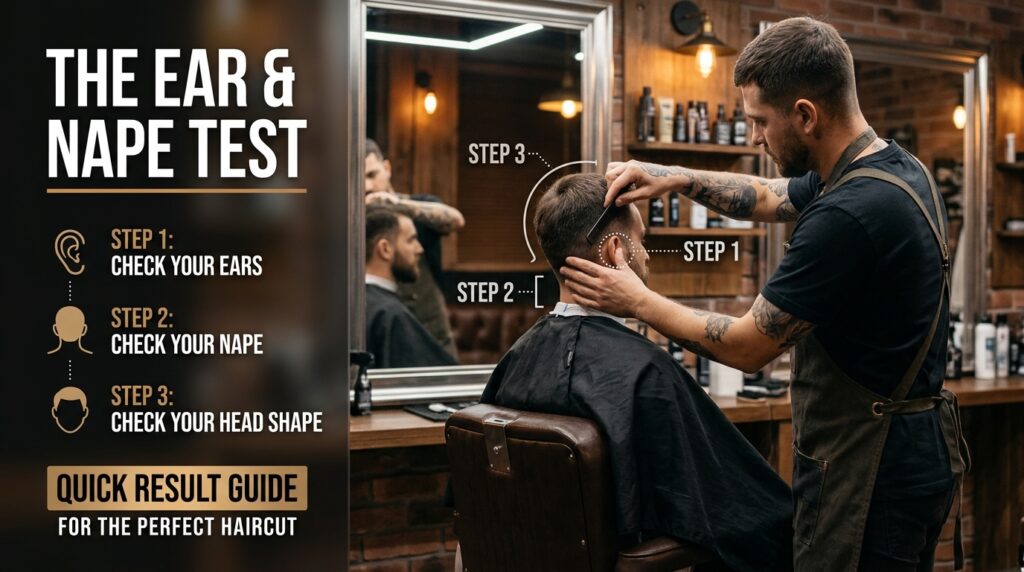
Not sure which fade to pick? Try this simple test. It focuses on two areas: your ear and your nape. The nape is the back of your neck.
Step 1: Check Your Ears
Look at your ears in the mirror. Do you like how they look? Are they small, large, or sticking out a bit?
A burst fade highlights the ear. It puts a clear frame around it. If you like your ears, this is a plus. If you feel unsure about them, a drop fade may feel more comfortable. It keeps the focus on the line, not the ear.
Step 2: Check Your Nape
Now look at the back of your neck. Is your neckline neat or uneven? Does your hair grow in a clean line or in a messy way?
A burst fade usually keeps longer hair at the nape. This hides any odd growth patterns. A drop fade shows the nape more. If your neckline is clean, the drop will look great. If it is patchy, the burst may be easier.
Step 3: Check Your Head Shape
Finally, feel the shape of your head. Is the back round or flat? Is your head narrow or wide?
- Round head: A drop fade gives a tidy edge.
- Flat back of head: A drop fade adds shape. A burst with longer back hair also hides it.
- Narrow head: A burst fade adds some width at the back.
- Wide head: A drop fade gives a slimmer line.
Quick Result Guide
| If you… | Try this |
| Like your ears and want length at the back | Burst fade |
| Want a clean neckline and a sleek shape | Drop fade |
| Have a messy neckline | Burst fade |
| Want to add shape to a flat head | Drop fade |
| Want a bit of both | Drop burst fade |
This test is not a strict rule. It is a helpful guide. Always talk to your barber. They can see your head shape in person and give better advice.
Choose the Finish Separately
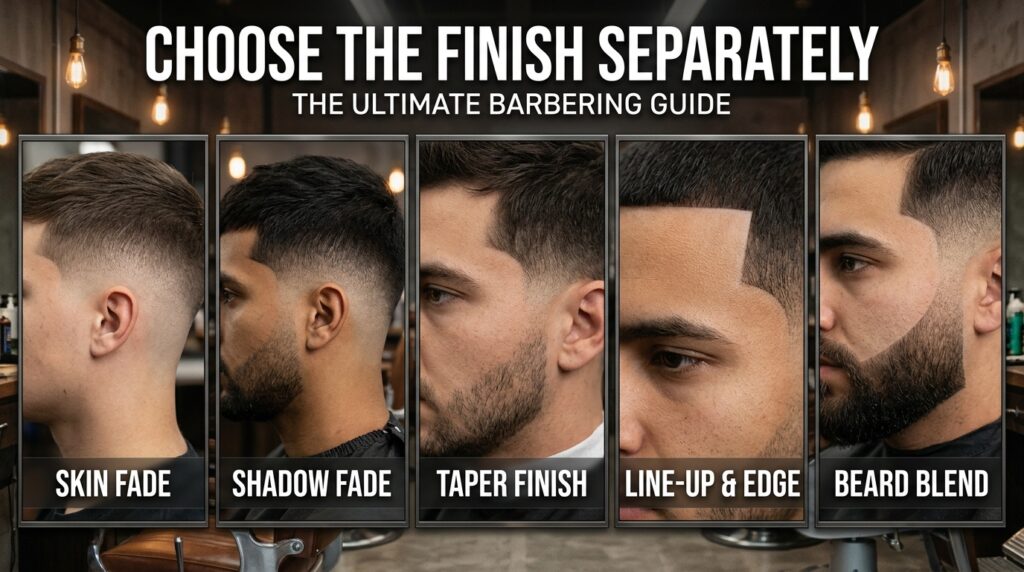
Many people forget this step. The fade type is only one part of the cut. The finish is a separate choice. It changes how the fade looks.
You can pick a burst or a drop, and then choose how skin-close the fade should be. Here are the main finish options.
Skin Fade
A skin fade goes down to bare skin. It gives the strongest contrast. It looks crisp and bold. It also grows out faster. You may need a cut every two weeks.
Shadow Fade
A shadow fade stops just before the skin. A thin layer of hair stays. It looks softer. It lasts longer. It is a good pick for people who do not want a harsh look.
Taper Finish
A taper finish keeps the fade subtle. It works well for office settings. You still get the shape of a burst or drop, but the look is calm.
Line-Up and Edge
A line-up cleans the hairline at the front. It gives a sharp edge. Some people also add a neckline clean-up. This is very common with drop fades on coily hair.
Beard Blend
If you have a beard, you can fade it into the side hair. This is called a beard blend. A burst fade pairs nicely with a beard because the curve around the ear flows into the beard line. A drop fade can blend into the beard along the jaw.
| Finish | Look | Maintenance |
| Skin fade | Sharp and bold | High |
| Shadow fade | Soft and smooth | Medium |
| Taper finish | Clean and subtle | Low |
| Line-up | Sharp edges | High |
Think of the fade type as the shape and the finish as the style. You can mix them. For example, you can get a mid burst fade with a shadow finish. Or you can get a low drop fade with a skin finish and a line-up.
This is how you make the cut yours. Talk to your barber about all three: the shape, the height, and the finish.
Which One Should You Choose?
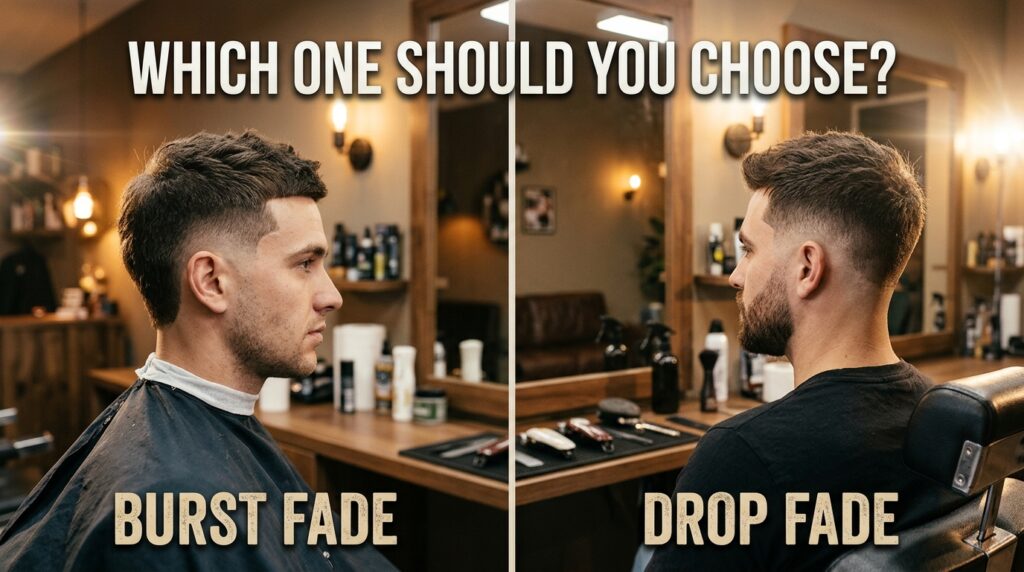
There is no single best fade. The right one depends on your hair, your style, and your habits. Use the lists below to guide you.
Choose a Burst Fade If…
- You want to keep length at the back of your head.
- You are getting a mullet or a long nape style.
- You have curly or wavy hair and want volume.
- You like a rounded, framed look around the ear.
- You do not want to visit the barber every week.
- Your neckline is uneven and you want to hide it.
- You want a trendy look that stands out.
A burst fade is playful. It suits people who like to show their style. It also works well for younger clients and creative workplaces. If you are not sure, a low or mid burst is a safe place to start.
Choose a Drop Fade If…
- You want a clean, sleek line at the back.
- You like a sharp and athletic look.
- You have a clear, neat neckline.
- You want to add shape to your head.
- You wear short crops, slick backs, or waves.
- You like a strong line-up and clean edges.
- You plan to see your barber every two to three weeks.
A drop fade feels polished. It suits sports, work, and formal events. It also looks great in photos, especially from behind.
A Simple Decision Table
| Your Priority | Best Choice |
| Longer back | Burst fade |
| Cleaner neckline | Drop fade |
| Mullet | Burst fade |
| Crisp, formal look | Drop fade |
| Low upkeep | Burst fade |
| Strong shape | Drop fade |
| A mix of both | Drop burst fade |
If you are still unsure, ask your barber to show you each option in the mirror before cutting. Many barbers will mark the line with a clipper guard or a comb. That helps you see the shape first.
Drop Burst Fade: Can You Combine Them?
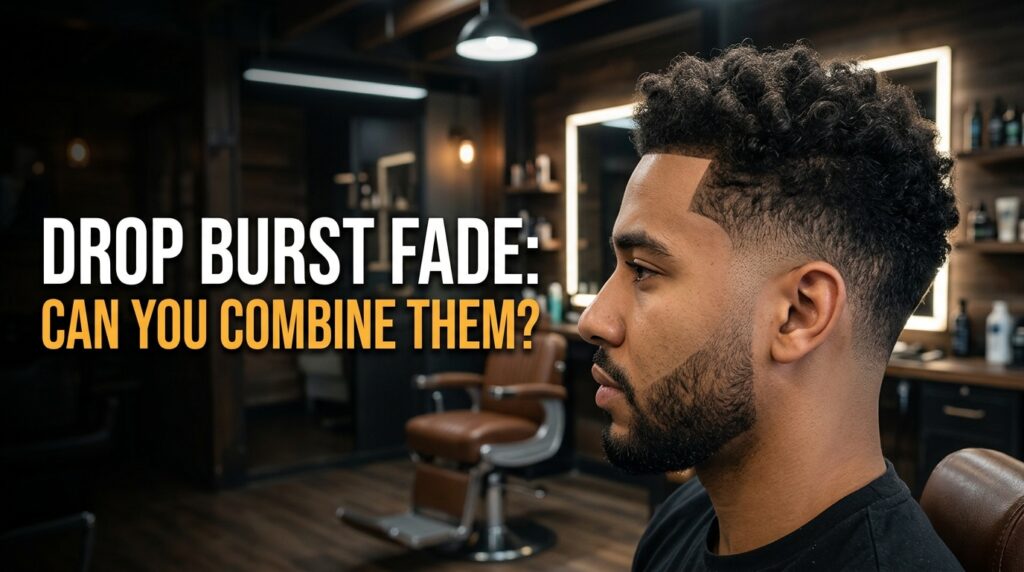
Yes, you can. A drop burst fade mixes the two ideas. The fade curves around the ear like a burst. Then it drops lower behind the ear like a drop fade.
The result is a long, flowing curve. It frames the ear and then sweeps down toward the neck. It looks smooth from every angle. It also shows off a barber’s skill.
Why People Like It
- It gives a bold look from the side.
- It still adds a clean line at the back.
- It keeps some volume at the nape if you want it.
- It works with many tops, from crops to curls.
Who Should Try It
This hybrid is good for people who cannot decide. It also suits people who like unique cuts. If you have a strong head shape and a neat neckline, you will get great results.
Watch Out For These Things
A mixed fade has more steps. That means more room for error. The curve must blend well. The drop must be even on both sides. If your barber is new to the style, ask to see their past work first.
It can also grow out in a less even way. The longer curve means more areas to clean up. Plan to visit every two to three weeks if you want to keep it sharp.
Names You May Hear
Barbers use different names for this style.
- Drop burst fade
- Burst drop fade
- Curved burst fade
- Dropped burst
All of these describe the same idea. If the name causes confusion, just describe it. Say, “I want a burst around the ear that drops lower behind it.” That is clear and simple.
How to Ask Your Barber
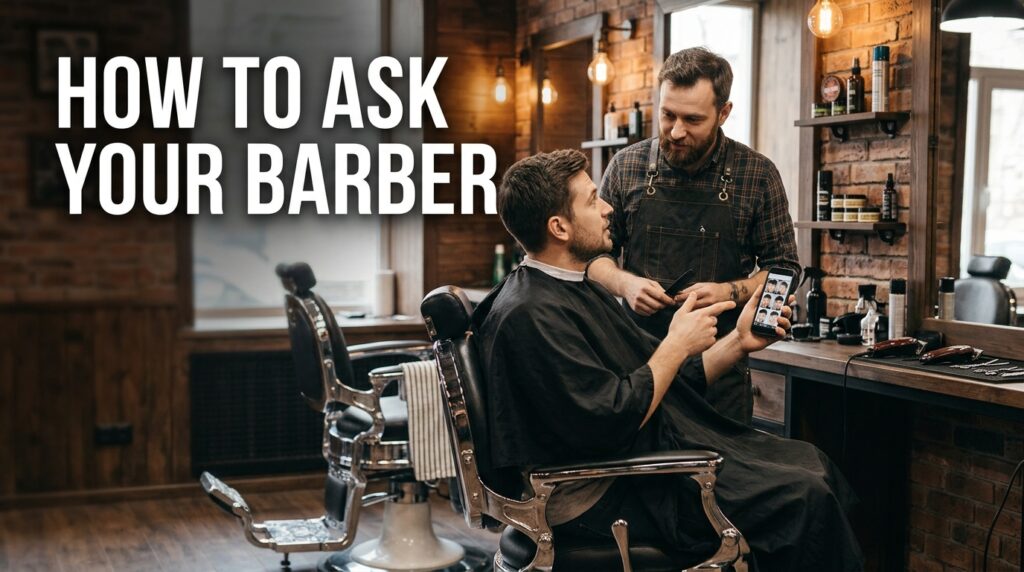
A great haircut depends on good communication. Barbers are skilled, but they cannot read your mind. Here is how to ask for what you want.
Bring Photos
Photos are the best tool. Bring at least three.
- A front view
- A side view
- A back view
The back view matters most for burst and drop fades. It shows the curve and the nape length.
Use Clear Words
Names can differ between shops. So describe your cut using simple parts.
Say something like this:
- “I want a mid burst fade with a shadow finish.”
- “Please keep the back long and fade around the ear.”
- “I want a low drop fade with a clean line-up.”
- “Leave the top longer, about three inches.”
Share Your Hair Type
Tell your barber if your hair is straight, wavy, curly, or coily. Also mention if it grows in odd directions. Cowlicks and thick patches change how the fade lies.
Talk About Your Routine
Tell the barber how you style your hair. Do you use a brush, a pick, or your hands? Do you use gel, cream, or pomade? Your routine affects how the top should be cut.
Ask Useful Questions
- Which fade will suit my head shape best?
- How long will this cut last?
- How should I style it at home?
- Can I see the line before you start?
Sample Script
“Hi. I would like a mid burst fade. I want the fade to curve around my ears and keep the back longer. I would like a shadow finish and a light line-up. I will keep the top at about three inches. Here are a few photos.”
That is clear, short, and polite. Most barbers will love it.
Check Before You Leave
Before you pay, check the cut. Use a hand mirror to see the back. Look at both ears. Make sure the lines match on both sides. If something looks off, ask politely for a quick fix. Good barbers want you to be happy.
Maintenance and Grow-Out
Fades look best when they are fresh. The shorter the fade, the faster it grows out. Here is how to keep your cut in shape.
How Often to Get a Trim
| Finish | Visit Every |
| Skin fade | 2 weeks |
| Shadow fade | 2 to 3 weeks |
| Taper finish | 3 to 4 weeks |
| Longer burst with long back | 4 to 6 weeks |
A drop fade often needs a touch-up sooner. The neckline shows regrowth fast. A burst fade with a long back can last a bit longer.
Daily Care Tips
- Wash gently. Use a mild shampoo. Rinse well.
- Moisturize. A dry scalp can flake and look dull. Use a light lotion or oil.
- Protect your hair at night. A satin cap or pillowcase keeps curls and waves in place.
- Brush if you have waves. A soft brush helps keep the pattern neat.
- Use the right product. Cream works for curls. Matte clay works for textured crops. Pomade works for slick styles.
Avoid Razor Bumps
Close fades can cause irritation. Here are some tips.
- Do not scratch the faded area.
- Keep the scalp clean and soft.
- Ask your barber to use a clean blade and a fresh guard.
- Use a soothing aftershave balm or a light moisturizer.
How Each Fade Grows Out
A burst fade grows out in a soft way. The curve around the ear blurs slowly. The back stays long, so you may not notice much change. Many people say it looks decent even at week four.
A drop fade grows out faster at the neck. The curved line fills in and looks less sharp. After two to three weeks, you may see a fuzzy neckline. A quick clean-up with the clippers fixes this.
Grow-Out Plan
If you want to grow your hair out, you can do it in stages.
- Switch to a longer finish, like a taper or shadow fade.
- Skip the skin and let the sides fill in.
- Keep the top trimmed to avoid a messy shape.
- Move to a classic taper or scissor cut as the sides grow.
A burst fade works well as a bridge to a mullet. You can keep the faded sides and let the back grow long. A drop fade is easier to grow into a clean, longer cut because the neckline stays tidy.
Home Touch-Ups
You can use a trimmer for the neckline between visits. But do not try to fade the sides yourself. That is best left to a pro. A small mistake can ruin the curve. If you want to clean up the neck, go slowly and use small strokes.
Frequently Asked Questions
What is the main difference between a burst fade and a drop fade?
A burst fade curves around the ear and keeps the back longer. A drop fade dips behind the ear and goes lower toward the neck.
Which is better for a mullet, a burst fade or a drop fade?
A burst fade is usually better for a mullet. It keeps length at the back while giving the sides a clean, rounded shape.
Can you get a burst fade and a drop fade together?
Yes. A drop burst curves around the ear like a burst and then drops behind it. Ask your barber for a mix of both.
How often should I get a burst or drop fade touched up?
Most people need a touch-up every two to four weeks. Skin fades and drop fades may need it sooner.
Do burst and drop fades work on curly or coily hair?
Yes. Both fades work very well on curly and coily hair. They give a clean frame and a crisp contrast with the top.
Final Thoughts
Burst fade and drop fade are both great cuts. A burst fade wraps around the ear and keeps the back longer. A drop fade curves behind the ear and gives a clean, sleek line at the neck. The right pick depends on your head shape, hair type, and style goals.
Use the ear and nape test to guide you. Choose your finish separately, and bring clear photos to your barber. If you cannot decide, a drop burst fade gives you a mix of both. Keep up with regular trims and simple care, and your cut will look sharp all month.

William Foster is a hair and beauty content writer at Easy Faxhion, sharing practical information about hairstyles, hair care, grooming, and styling. He focuses on clear, reader friendly articles supported by careful research and thoughtful content development, helping readers discover useful ideas and make informed everyday hair care choices.