


A textured fringe is one of the easiest ways to look sharp without looking like you tried too hard. It has movement. It has shape. It works on a quiet Monday and at a Saturday night dinner.
In 2026, this cut is still everywhere in the US. Barbers love it because it suits many hair types. Guys love it because it takes five minutes to style. If you want a fresh look that feels modern and relaxed, this guide will help you pick the right one.
Here are the five textured fringe styles that stand out most this year:
| Rank | Style | Best For | Effort Level |
| 1 | Short choppy textured fringe | Straight or thick hair, busy mornings | Low |
| 2 | Textured crop (French crop) | Thin or receding hairlines | Low |
| 3 | Long textured fringe | Medium to thick hair, creative looks | Medium |
| 4 | Wavy textured fringe | Natural waves, relaxed style | Low to medium |
| 5 | Curly or coily textured fringe | Curls and coils, volume lovers | Medium |
Below, you will learn what makes a fringe textured, how to match it to your hair, what to tell your barber, and how to style it at home.
Textured Fringe visual references
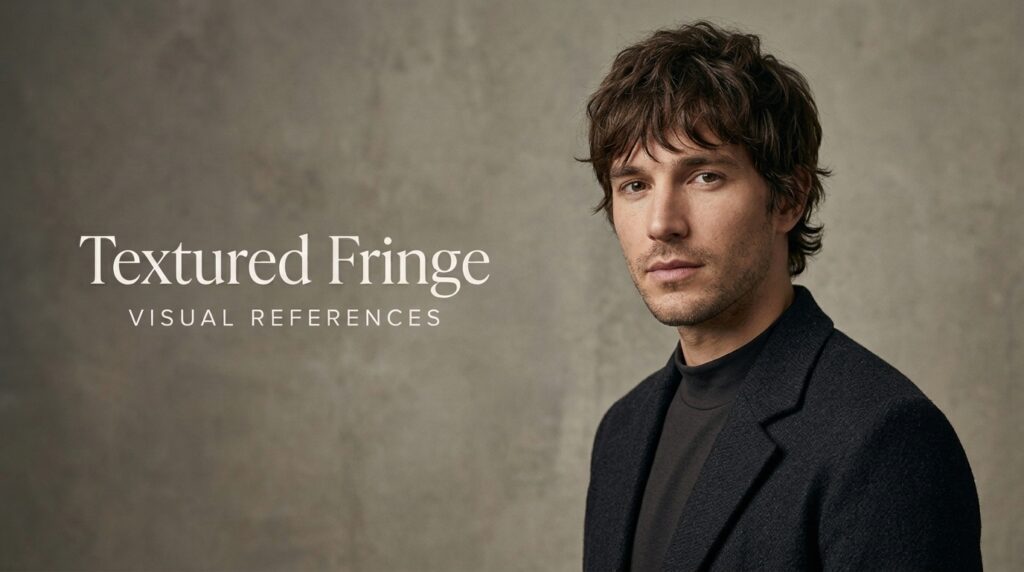
Before you book a haircut, look at photos. Words can be vague. The picture is clear. Barbers also love when a client shows a real example.
The term “textured fringe” covers many looks. That is why search results can feel confusing. One photo shows a short, spiky front. Another shows long hair falling over the forehead. Both are textured fringes, but they feel very different.
Here is a simple guide to the most common visual looks and what to search for.
| Look | What You See | Good Search Phrase |
| Messy fringe haircut male | Loose, piecey front with a natural, uneven finish | “messy fringe haircut male” |
| Short textured fringe hairstyles for men | Fringe about 1 to 2 inches long, cut with choppy ends | “short textured fringe hairstyles for men” |
| Medium textured fringe hairstyles for men | Fringe that reaches the eyebrows, with layers on top | “medium textured fringe hairstyles for men” |
| Long textured fringe hairstyles for men | Fringe that falls past the brows, often swept to the side | “long textured fringe hairstyles for men” |
| Textured fringe hairstyles for men with long hair | Long layers all over, with a face-framing front | “textured fringe hairstyles for men with long hair” |
| Haircut fringe male | The general base cut, often a simple forward-combed front | “haircut fringe male” |
| Textured fringe straight hair male | Sharp, defined pieces on straight strands | “textured fringe straight hair male” |
| Textured fringe low taper | Clean, soft taper at the sides and neck | “textured fringe low taper” |
How to use photos the right way
Save two or three pictures. Do not save just one. This gives your barber a range to work from.
Pick photos of men with hair like yours. Check hair thickness, curl pattern, and hairline. A style that looks great on thick, dark hair may look flat on fine, light hair.
Also look at the sides and the back. Many people only look at the front. The sides decide how clean or relaxed the whole cut feels.
What Makes a Fringe “Textured”?
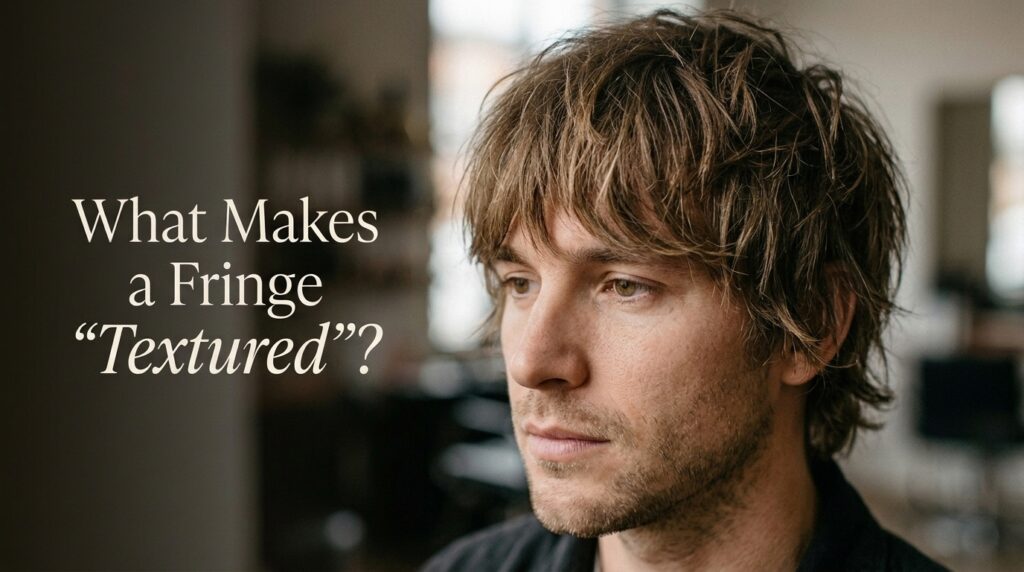
A fringe is the hair that falls over your forehead. It is also called bangs in the US. A regular fringe is cut in one clean, even line. It looks neat and flat.
A textured fringe is different. The barber cuts the ends at different lengths. This creates small gaps and pieces. The hair does not lie flat. It moves, lifts, and separates.
That is the whole idea. Texture means the front looks lived in, not stiff.
The tools behind the texture
Barbers use a few simple tricks to build texture. You do not need to learn them, but it helps to know the words.
- Point cutting: The barber snips into the ends of the hair at an angle. This breaks up a hard line.
- Slide cutting: The scissors glide along the hair to remove weight and soften the ends.
- Razor cutting: A razor creates light, feathered ends. It works best on straight or wavy hair.
- Thinning shears: These remove bulk. Good barbers use them with care so the hair does not look thin.
- Layering: The top is cut shorter than the front, so the hair stacks and lifts.
Why texture looks better than a blunt fringe
A blunt fringe can look heavy. It can also look young or too neat for some faces. Texture softens the look. It adds a casual feel.
Texture also hides small flaws. A slightly uneven hairline or a cowlick looks less obvious when the front has movement. That makes the cut forgiving, which is a big win for daily wear.
Compare your preferences first

Do not start with the haircut. Start with yourself. A great cut on the wrong person can still feel off. A few quick questions will save you time and money.
Think about your daily routine. Do you want to spend two minutes on your hair, or ten? Do you work in an office, a gym, a job site, or from home? Your lifestyle matters as much as your face shape.
A quick preference checklist
Ask yourself these questions:
- How much time do I want to spend styling each morning?
- Do I like a clean, sharp look or a messy, relaxed look?
- Is my hair straight, wavy, curly, or coily?
- Is my hair thick, medium, or fine?
- How often can I visit a barber? Every three weeks, or every two months?
- Do I wear hats, helmets, or hard hats often?
Match your answers to a direction
| If You Want | Choose |
| Very low effort | Short choppy fringe or textured crop |
| A bold, creative look | Long textured fringe |
| A clean, professional finish | Textured fringe with a low taper |
| Natural, easygoing style | Wavy textured fringe |
| Maximum volume and shape | Curly or coily textured fringe |
| A sharp, modern edge | Textured fringe with a fade |
Be honest about your habits. If you hate using products, avoid styles that need a lot of it. If you only get a trim twice a year, skip tight fades.
Read More: Best Mid Taper Fade Haircuts for Black Men
Textured Fringe Haircut Types
There are many ways to wear a textured fringe. The front stays similar, but the length, the sides, and the hair type change the look. Here are the main types to know.
Short Choppy Textured Fringe
This is the easiest place to start. The hair on top is short, usually one to two inches. The front is cut with uneven, choppy ends.
It works well for guys who want a low-maintenance cut. You can style it with your fingers and a little paste. It looks great on straight and slightly wavy hair.
Why guys like it:
- It dries fast.
- It holds shape well in humid weather.
- It grows out without looking messy for weeks.
Watch out for: Very fine hair can look sparse if cut too short. Ask for a little length in the front to keep it full.
Long Textured Fringe
A long fringe falls past the eyebrows. Some guys sweep it to the side. Others push it back or let it fall forward. It has a moody, artistic feel.
This style needs good layering. Without layers, long hair can feel heavy and flat. With the right cut, it moves nicely and has a natural shape.
Long textured fringes are popular with guys who have medium to thick hair. They also work well with a stronger jawline, since the hair frames the face.
Tips for long fringes:
- Get a trim every six to eight weeks to remove split ends.
- Use a light product, such as sea salt spray or a cream.
- Keep the hair clean. Long hair looks greasy faster.
Wavy Textured Fringe
Wavy hair already has built-in texture. A good cut simply works with it. The barber trims the front to follow the natural wave and removes extra bulk so it does not puff out.
This style is one of the most natural looking. It suits guys who want a relaxed, beachy feel without much work.
The key is the right length. Too short, and the waves can spring up and look odd. Too long, and they can turn into a heavy mop. Medium length, around two to four inches on top, usually works best.
Styling idea: Apply a small amount of cream to damp hair. Scrunch it lightly and let it air dry. Finish with a dab of matte clay for hold.
Curly or Coily Textured Fringe
Curly and coily hair has great shape and volume. A textured fringe on curls looks bold and full. It also gives you plenty of ways to play with length.
The barber should cut curly hair with care. Many curls are best cut when dry, so the barber can see how each curl falls. Cutting too much off the front can make curls shrink and jump up.
Hair care matters most here. Curls need moisture. Without it, the fringe can look dry and frizzy.
Good habits for curls and coils:
- Use a leave-in conditioner or curl cream.
- Avoid brushing dry curls. Use your fingers or a wide-tooth comb.
- Sleep on a satin pillowcase or wear a satin bonnet to keep the shape.
Textured Crop or French Crop
The French crop is short on the sides and has a short, forward-falling fringe. The front is cut straight across, but with texture so it is not flat. It looks sharp and tidy.
This is a smart option for guys with a receding hairline or a high forehead. The fringe sits low and hides the hairline. It also needs almost no styling.
It works best on straight to wavy hair. On very curly hair, a crop can still work, but the barber may need to adjust the shape.
| Feature | Textured Crop |
| Top length | 1 to 3 inches |
| Front | Short, forward, textured |
| Sides | Faded or tapered |
| Styling time | 1 to 3 minutes |
| Best for | Thinning hair, high forehead |
Textured Fringe With a Low Taper
A low taper keeps the sides and neck neat without a bold fade. The hair gets shorter gradually near the ears and the nape, but it stays soft and natural.
This is the most “safe” choice for many US workplaces. It looks clean, but it does not shout. It also grows out nicely.
Pair a low taper with a medium or long fringe for a balanced look. The top stays full and soft. The sides stay tidy.
Good to know: A low taper starts below the ear. It is more subtle than a mid or high taper. If you want a more dramatic contrast, ask for a higher start point.
Textured Fringe With a Fade
A fade takes the sides down to very short hair, sometimes to the skin. The change from short to long is smooth. Paired with a textured fringe, it creates a strong contrast.
This is a popular modern look. The sharp sides make the messy top look intentional. It suits guys who like a crisp, bold appearance.
Fades come in different heights:
- Low fade: Starts near the ears and the neckline.
- Mid fade: Starts around the temples.
- High fade: Starts high on the head, near the crown.
Fades need frequent touch-ups. Plan a visit every two to three weeks to keep the line clean.
Textured Fringe With Scissor-Cut Sides
Not every guy wants clippers. Scissor-cut sides keep the hair soft and natural. The barber uses scissors and a comb to blend the sides into the top.
This gives a relaxed, classic look. It also grows out gracefully, since there is no hard line to lose. It suits medium and long fringes very well.
It is a great pick if you have sensitive skin on your neck, or if you simply dislike the buzzed look. The tradeoff is that it takes a bit longer in the chair. Skilled barbers can do it well, so choose one who is comfortable with scissor work.
Which Textured Fringe Works With Your Hair?
Your hair type plays a big role. The same cut can look totally different on straight, wavy, or curly hair. Match the style to what your hair already does.
Straight hair
Straight hair shows texture clearly. Sharp, choppy ends look great. A short choppy fringe or a French crop is a strong choice.
The challenge is that straight hair can fall flat. Use a texture powder or a sea salt spray at the roots for lift. Matte clay helps keep the pieces separate.
Wavy hair
Wavy hair is the easiest for this style. It has natural movement, so the fringe looks effortless. A medium textured fringe with a taper or scissor-cut sides is a great match.
Let your waves do the work. Avoid heavy gels, which can weigh them down and turn them stiff.
Curly and coily hair
Curly and coily hair gives the most volume. A textured fringe with defined curls looks full and stylish. Keep the length balanced so the curls do not take over your face.
Moisture is the main rule. Dry curls lose shape and look rough.
Thick vs. fine hair
| Hair Thickness | Best Fringe Choice | Tip |
| Thick | Long or medium textured fringe | Ask for thinning to remove bulk |
| Medium | Almost any style | Easy to shape, very flexible |
| Fine | Short crop or choppy fringe | Avoid heavy thinning, use texture powder |
Hairline and face shape
If your hairline is receding, choose a forward fringe like a French crop. If you have a high forehead, a longer fringe can cover it.
For a round face, add height on top and keep the sides short. For a long or oval face, a fringe that falls forward helps shorten the look. A square jaw suits nearly any fringe.
How Long Should a Textured Fringe Be?
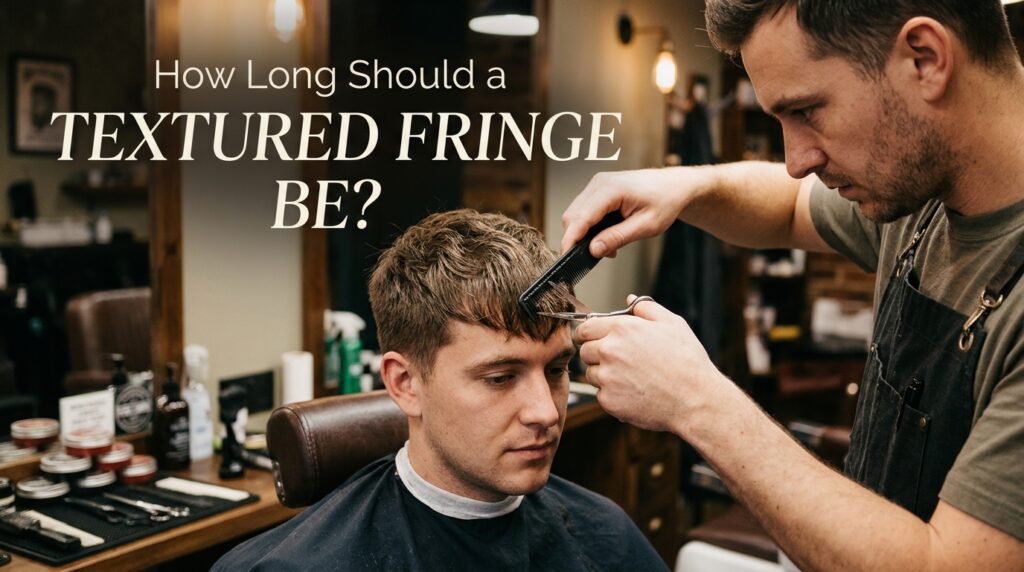
Length changes the feel of the whole cut. A short fringe looks sharp and clean. A long fringe looks soft and moody. Pick the length that fits your style and your daily life.
Think of fringe length by where it lands on your face. Use this as a rough map.
| Fringe Length | Where It Lands | Overall Feel |
| Short | Above the eyebrows | Neat, sharp, low effort |
| Medium | At the eyebrows | Balanced, versatile |
| Long | Past the eyebrows, near the eyes | Relaxed, creative, dramatic |
How to pick your best length
Start with your comfort. If hair in your eyes drives you crazy, stay short or medium. If you like to push hair back or sweep it aside, go longer.
Consider your hair type too. Curly hair shrinks when it dries. A fringe that looks eyebrow length when wet may rise to the forehead once dry. Ask your barber to cut a bit longer to allow for this.
Straight hair keeps its length. What you see is what you get.
Growing out a fringe
If you want to grow your fringe, give it time. Hair grows about half an inch per month. A two inch change takes around four months.
During this stage, keep the sides trimmed. It stops the whole head from looking shaggy. Use a trim every eight weeks to keep the ends healthy.
How to Ask Your Barber
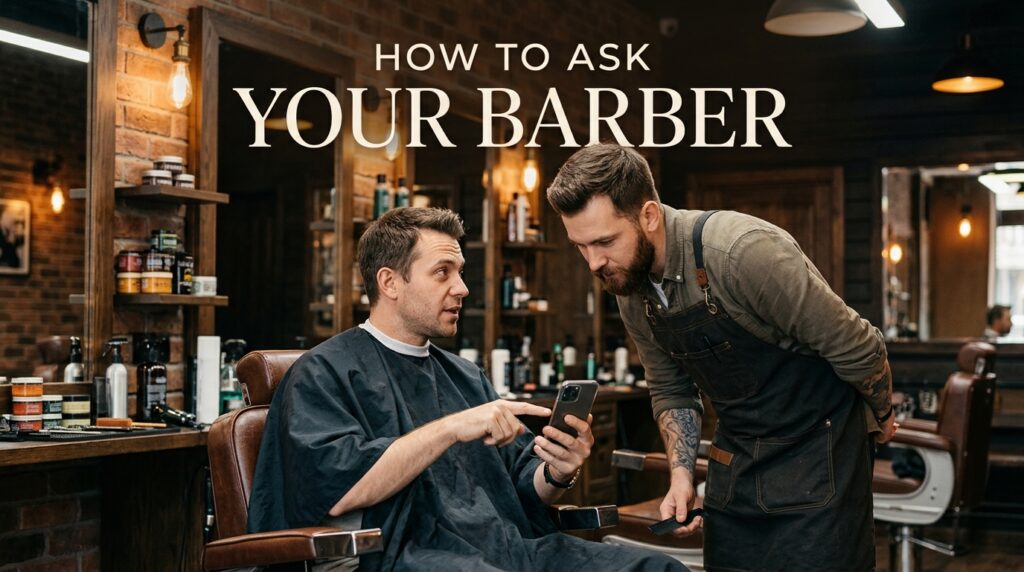
Many bad haircuts come from poor communication. The fix is simple. Be clear, be specific, and bring photos.
Barbers use their own terms. You do not have to know them all. But a few key phrases will help you get what you want.
Words to use at the chair
- “I want a textured fringe, cut with choppy or piecey ends.”
- “Please leave the front at about eyebrow length.”
- “I’d like a low taper on the sides and the neck.”
- “Keep the top long enough to style with my fingers.”
- “Use scissors on the sides, not clippers, please.”
Numbers beat words
“A little off the top” can mean anything. Use numbers when you can. Clipper guards, like a number 2 or a number 3, and inches on top are far clearer.
| What You Say | What It Means |
| “Low taper” | Short sides that start low, below the ears |
| “Mid fade” | Fade that begins around the temples |
| “Scissor-cut sides” | No clippers, softer finish |
| “Take weight out” | Thin the hair so it looks lighter |
| “Leave it longer in front” | Keep the fringe length, trim the rest |
A short script you can use
“Hi, I’d like a textured fringe. I’m looking for about two inches on top, with the front around my eyebrows. Can you do a low taper on the sides? I want it easy to style with clay. Here are a couple of photos.”
Also tell your barber how you style your hair each day. Say if you use a blow dryer, if you let it air dry, or if you use nothing at all. This helps them cut for your real routine.
Ask before you leave
Before you leave the chair, ask for a quick styling lesson. Ask which product they used and how much. Also ask how often you should return. Good barbers are happy to share this.
How to Style a Textured Fringe
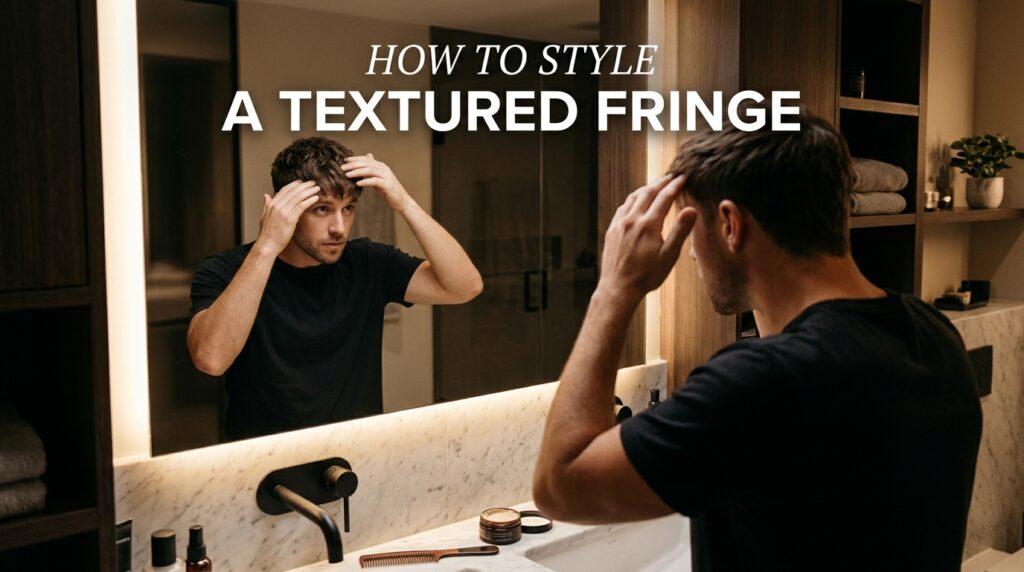
Styling a textured fringe is simple. The goal is to look natural, not perfect. Spend a few minutes and use the right product.
What you need
- A towel
- A blow dryer (optional but helpful)
- Sea salt spray or pre-styler
- A matte clay, paste, or cream
- A comb or your fingers
Step-by-step styling
- Start with damp hair. Towel dry until it is not dripping. Wet hair is hard to shape.
- Add a pre-styler. Spray a little sea salt spray or mousse. This adds grip and lift.
- Blow dry for shape. Dry the fringe forward first. Then lift it up with your fingers. This builds volume at the roots.
- Warm a small amount of product. Rub a pea-sized amount of clay or paste between your palms.
- Work it through the front. Use your fingertips. Pinch and twist small sections to build texture.
- Finish with a light touch. Check the mirror. Fix any piece that looks off.
Best product by hair type
| Hair Type | Product | Why |
| Straight | Matte clay or texture powder | Adds grip and lift |
| Wavy | Sea salt spray plus light cream | Boosts natural wave |
| Curly | Curl cream or leave-in conditioner | Keeps moisture and definition |
| Fine | Texture powder | Adds volume without weight |
| Thick | Paste or pomade | Controls bulk |
Three common looks from one cut
Forward and messy: Comb the fringe down and break it up with clay. This is the classic messy look.
Swept to the side: Blow dry the fringe sideways. Use a light paste to hold it.
Pushed up and back: Use a bit more product and lift the front with your fingers. This gives a bolder, taller shape.
The more you play, the better you get. Spend a week learning how your hair moves. You will soon find your favorite look.
Maintenance and Common Problems
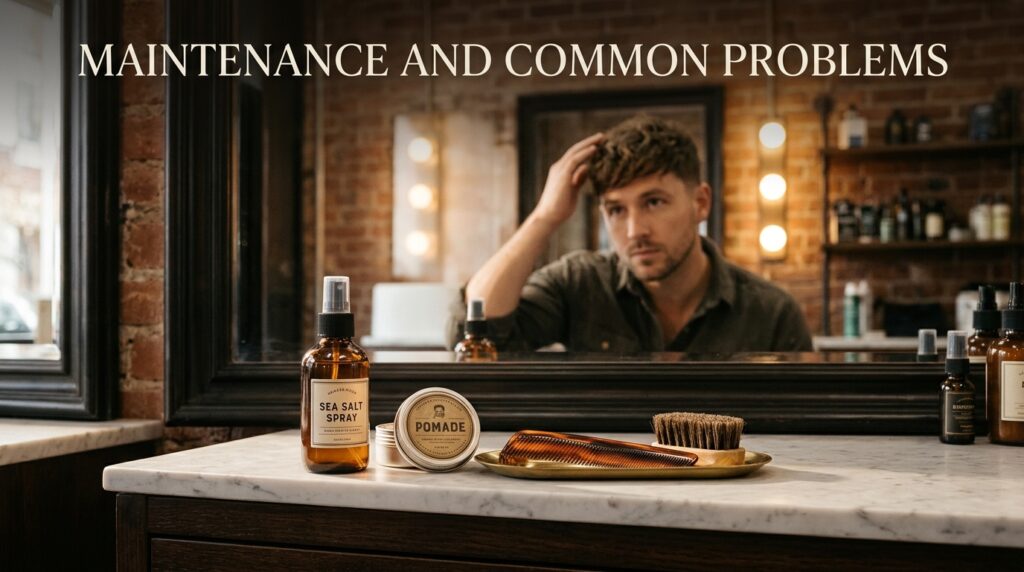
A textured fringe is easy, but it still needs care. A few habits keep it looking fresh. They also prevent the common problems below.
Regular upkeep
How often you need a trim depends on the style.
| Style | Trim Every |
| Fade or short sides | 2 to 3 weeks |
| Low taper | 3 to 4 weeks |
| Scissor-cut sides | 4 to 6 weeks |
| Long textured fringe | 6 to 8 weeks |
Wash your hair two to four times a week. Over-washing can dry out your scalp. Under-washing can make hair greasy and flat. Use a gentle shampoo and a conditioner on the ends.
Common problems and easy fixes
Problem: The fringe looks flat. Fix: Use a pre-styler and blow dry at the roots. Add a little texture powder.
Problem: Too much product build-up. Fix: Use a clarifying shampoo once a week to wash it away.
Problem: A cowlick at the front. Fix: Ask your barber to cut the front a bit longer so the weight holds it down. You can also blow dry the hair in the direction it grows, then reshape it.
Problem: The fringe falls into your eyes. Fix: Ask for a slightly shorter cut, or style it up and back with a bit of paste.
Problem: It looks frizzy or dry. Fix: Use a leave-in conditioner or a few drops of hair oil. Cut back on hot tools.
Problem: The cut looks too thin or stringy. Fix: Skip heavy thinning on your next visit. Tell your barber to keep more weight.
Problem: It grows out messy. Fix: Keep the sides and neck tidy between full cuts. A quick neckline clean-up goes a long way.
Small habits that help
- Sleep on a clean pillowcase.
- Protect hair from heat with a heat spray.
- Do not over-use strong gels or waxes.
- Take a few minutes at night to rinse off heavy products.
These small steps keep your hair healthy. Healthy hair holds texture far better.
Sources and Further Reading
This guide uses common barbering practice and general hair care knowledge. For deeper reading, you can look at trusted sources in these areas.
- Professional barber education: Barbering schools and licensed barbers often share tips on fringe cutting, tapering, and fades.
- Dermatology resources: The American Academy of Dermatology offers advice on healthy scalp care, hair washing, and dandruff.
- Men’s grooming publications: Established men’s style magazines and grooming sites regularly publish haircut trend reports.
- Hair product brands: Many brands publish how-to guides for using clay, paste, and sea salt spray.
- Your own barber: A good local barber knows your hair and can give advice no article can match.
Trends shift each year, and product formulas change. Always check recent photos and talk with a professional before making a big change.
Frequently Asked Questions
What is a textured fringe haircut for men?
A textured fringe is a front section cut with uneven, choppy ends. It falls over the forehead with natural movement instead of a flat, straight line.
What is the best textured fringe for straight hair?
A short choppy fringe or a French crop works best on straight hair. Both show sharp texture and need very little styling.
How long should a textured fringe be?
Most men choose a length from just above the eyebrows to just past them. Pick shorter for a neat look and longer for a relaxed style.
Can curly hair have a textured fringe?
Yes. Curly and coily hair can pull off a textured fringe very well. Ask your barber to cut it dry and keep the curls moisturized.
How often should I get my textured fringe trimmed?
Trim every three to four weeks for tapers or fades. Long fringes with scissor-cut sides can wait six to eight weeks.
Final Thoughts
A textured fringe is one of the most flexible haircuts for men in 2026. It works on straight, wavy, and curly hair. It fits short, medium, and long lengths. Pair it with a low taper, a fade, or scissor-cut sides, and you can shift the look from soft to bold.
The best choice comes down to your hair type, your face, and your daily routine. Bring clear photos to your barber and describe what you want in simple terms. Then learn a quick styling routine. With a little practice, your fringe will look natural, sharp, and easy to wear every day.

William Foster is a hair and beauty content writer at Easy Faxhion, sharing practical information about hairstyles, hair care, grooming, and styling. He focuses on clear, reader friendly articles supported by careful research and thoughtful content development, helping readers discover useful ideas and make informed everyday hair care choices.